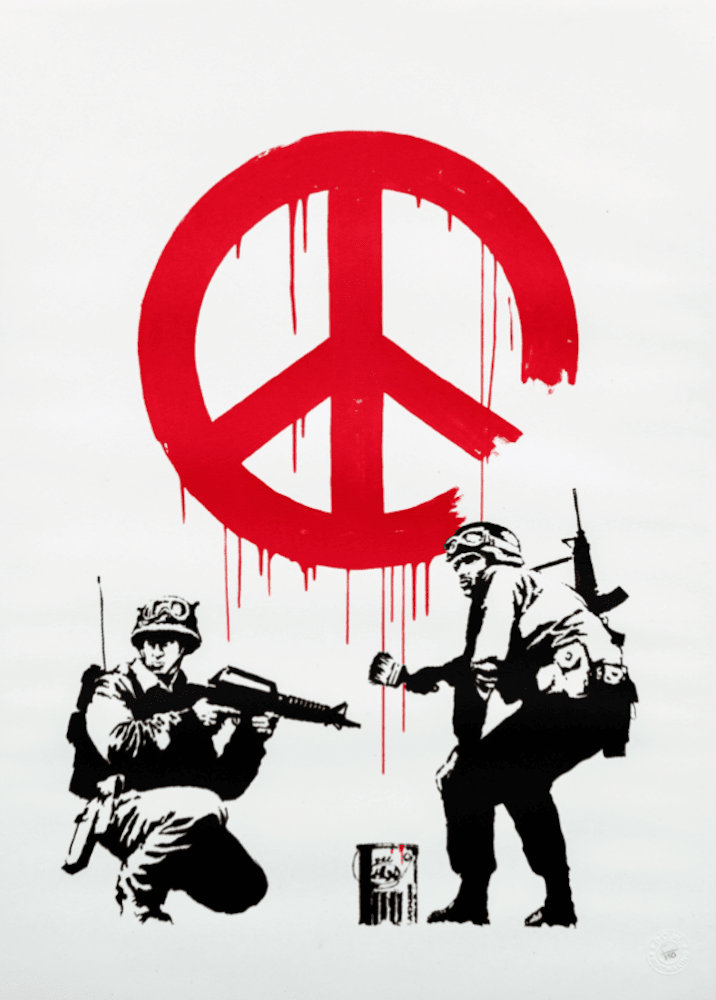
From Bristol alleyways to Sotheby's auction rooms—the guerrilla artist who turned spray paint into social commentary and stencils into seven-figure statements.
Own a Banksy?
Zebra One Gallery specialises in Banksy consignment and resale. We only handle works that already carry a Pest Control Office Certificate of Authenticity, and connect you with serious collectors worldwide.
Pest Control COA Required
We only handle works with an existing Pest Control Certificate of Authenticity
Competitive Rates
Transparent commission structure
Global Network
Access to serious international collectors
30+
Years Active
£25.4M
Auction Record
150+
Print Editions
Still
Anonymous
Who Is Banksy?
Here's what we know: somewhere around 1974, in Bristol, England, a kid was born who would grow up to become the art world's greatest paradox. Banksy—no first name, no face, no confirmed identity—has spent three decades leaving his mark on walls from Palestine to Los Angeles while keeping his own story firmly in the shadows.
The name might be a nod to Robert Banks, the moniker his mother supposedly called him. Or it could be Robin Gunningham, as investigative journalists have suggested. In 2026, fresh claims emerged linking him to someone else entirely. But here's the thing: it doesn't matter. The work speaks louder than any birth certificate ever could.
What started as late-night Bristol graffiti runs in the 1990s has evolved into a global phenomenon. His stenciled rats, kissing policemen, and flower-throwing rioters have become the visual language of dissent for a generation. When a Banksy appears overnight on a city wall, it makes international headlines. When one of his canvases hits the auction block, it shatters records. And when he pulls off a stunt—like shredding a painting the moment it sold for over a million pounds—the art world collectively loses its mind.
Early 1990s
Bristol's Backstreets
Picture Bristol in the early '90s: a port city with a thriving underground scene, where graffiti crews like DryBreadZ (DBZ) were claiming walls and railway bridges as their canvas. Young Banksy was there, spray can in hand, painting freehand pieces alongside artists like Kato and Tes. The work was bold, colorful, and utterly illegal.
Then came the night that changed everything. Hiding beneath a garbage truck while police swept the area, Banksy noticed something: the vehicle's stenciled serial number. In that moment, crouched in the dark with his heart racing, he realized stencils could deliver the same punch as freehand work—but in a fraction of the time.
By 2000, he'd abandoned the spray can entirely. The stencil became his signature. Cut intricate designs at home, arrive at the location, execute in minutes, disappear into the night. It was guerrilla artistry at its finest—and it worked.
His first major piece, *The Mild Mild West* (1997), still stands in Bristol's Stokes Croft: a teddy bear hurling a Molotov cocktail at three riot police. It's become a local landmark.
The Full Story
Three Decades, One Anonymous Voice
A continuous record of every era, work, exhibition and stunt that built the most famous anonymous artist on earth.
The artist known as Banksy has, for three decades, remained the most famous anonymous figure on earth. Born around 1974 in Bristol, England, he grew into a figure whose work now functions as a visual record of 21st-century dissent — satirical, political, and often devastatingly funny. His story unfolds not in gallery catalogues but on walls, under bridges, and in derelict buildings, and it begins in the backstreets of a port city with a thriving underground scene.
Era 1 · 1995–2002
Bristol Roots & the Stencil Revolution
In the mid-1990s, Banksy was a freehand graffiti writer operating with the DryBreadZ crew, often alongside two other artists known as Kato and Tes. His work was bold, colourful, and entirely illegal — pieces thrown up on trains, walls, and bridges around Bristol. By 1999, his first major street piece appeared on Stokes Croft: The Mild Mild West, a teddy bear hurling a Molotov cocktail at three riot police. Painted in broad daylight over three days, it was a direct response to police raids on the city's unlicensed warehouse parties and remains a local landmark to this day.
The Mild Mild West, Stokes Croft, Bristol — a teddy bear hurling a Molotov cocktail at three riot police. · Photo: Eirian Evans · CC BY-SA 2.0
The shift that would define his career came after a close call with the law. Hiding beneath a garbage truck while police swept the area, he noticed the vehicle's stencilled serial number. In that moment, he understood that pre-cut stencils could deliver the same visual punch as freehand work in a fraction of the time, dramatically reducing the risk of arrest. By the late 1990s, he had all but abandoned the spray can for stencils. Cut the design at home, arrive at the location, execute in minutes, disappear into the night.
His first major solo exhibition took place in 2000 at the Severnshed, a former boat workshop in Bristol's floating harbour. But it was the move to London that same year that placed him at the centre of a new movement. Shoreditch at the time was bleak and cheap; taxis wouldn't go there after dark. At the bottom of Leonard Street stood the Dragon Bar, a venue opened in 1998 by Justin Piggott and kept alive by Adi Hall. With graffitied toilets, block parties out back, and an upstairs gallery given free to artists, it became a creative melting pot. Ben Eine worked behind the bar. Guerrilla artists from across the UK converged here to make work, display, spray, drink, and argue into the small hours.
Banksy's first London exhibition was not in a gallery but in the Rivington Street tunnel, a scruffy cut-through beneath a railway line that today houses the Cargo nightclub. Following a pub argument about how easy it would be to stage an unsanctioned show, he returned a week later with buckets of paint, a forged invoice from a fictitious arts organisation, and decorators' signs stolen from a building site. Dressed in overalls, he and his accomplices painted the tunnel walls white, then executed over a dozen stencils — including the Laugh Now chimpanzees and the Flower Thrower — in twenty-five minutes flat. The opening party on 31 May 2000 featured beer and hip-hop from the back of a transit van.
It was at the Dragon Bar, however, that Banksy staged his first proper London show. In December 2002, the venue hosted the inaugural Santa's Ghetto, a squat art concept store featuring work by Banksy and Eine. The event became an annual tradition that ran until 2007, moving to locations across London and eventually to Bethlehem. Santa's Ghetto was the primary outlet for the release of original canvases and limited-edition prints through the collective known as Pictures on Walls — and it is through these events that collectors first gained access to works now commanding vast sums.
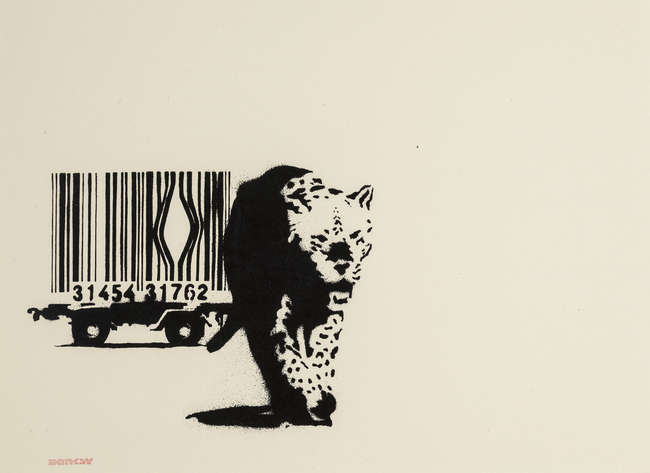
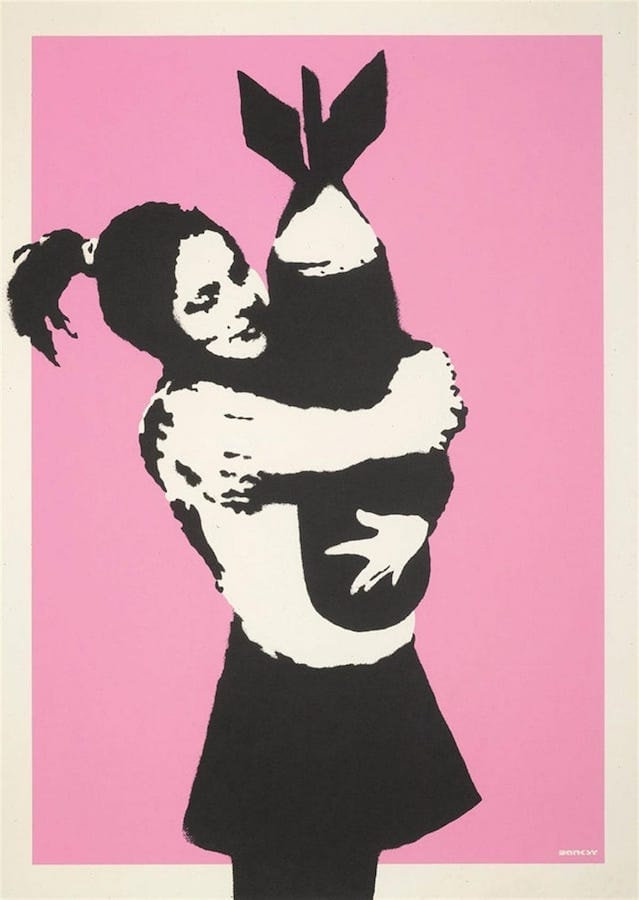
The year 2002 also saw Girl with Balloon appear for the first time, stencilled on a wall beneath a flight of steps on Great Eastern Street, London, with the words "THERE IS ALWAYS HOPE" brushed beside it. That same image would later become his most iconic symbol. Meanwhile, his first American solo show, Existencilism, opened at the 33⅓ Gallery in Los Angeles, introducing American audiences to works such as Barcode, Bomb Hugger, and Love Is In The Air. A reduced version of the show travelled to Japan shortly after.
Girl with Balloon — first stencilled in 2002 on a wall beneath a flight of steps on Great Eastern Street, London. · Photo: Paul Boudreau · CC BY 2.0
Between 2001 and 2004, Banksy self-published a trilogy of small-format paperbacks that functioned as manifestos and portfolios. Banging Your Head Against a Brick Wall (2001) was a pocket-sized collection of stencils and satirical commentary. Existencilism(2002) launched alongside a street show in a Southwark tunnel and opened with the line: "Like most people I have a fantasy that all the little powerless losers will gang up together." The third volume, Cut It Out, completed the set. These books are now highly sought-after artefacts from a time before the mainstream had noticed.
Era 2 · 2003–2010
Global Infiltration & the Prankster
In July 2003, Banksy staged his first major UK exhibition, Turf War, in a warehouse on Kingsland Road, Dalston. The location was kept secret until the last moment. The show was a riot of installations, graffiti, and live farmyard animals — sheep, pigs, and a bull — all spray-painted in various patterns. Animal rights protesters locked themselves to the pens, shutting the exhibition early. Among the works on display was a painting of Winston Churchill suspended from the ceiling, and a Madonna reinterpretation that would become an enduring motif. A recently rediscovered BBC interview from this period captured the artist at work, casually confirming his first name as "Robbie."
The global scale of his ambition became clear in 2004 when he secretly entered the Louvre in Paris and hung his own version of the Mona Lisa, altered with a yellow smiley face, on the wall. It was an audacious institutional prank, but it was his trip to the West Bank the following year that gave his work a new political gravity. In 2005, he travelled to the Israeli West Bank barrier and painted nine murals directly onto the concrete slabs, including a dove wearing a flak jacket and a child digging a hole through the wall. The images blended protest with poetry and became some of his most cited works.
October 2005 saw Crude Oils, a two-day exhibition in a basement in west London, featuring over 200 live rats scurrying freely around the space and "remixed" versions of canonical masterpieces — a Monet, a Van Gogh, and Jack Vettriano's The Singing Butler all reworked with irreverent additions. Admission was free if you could stomach the company.
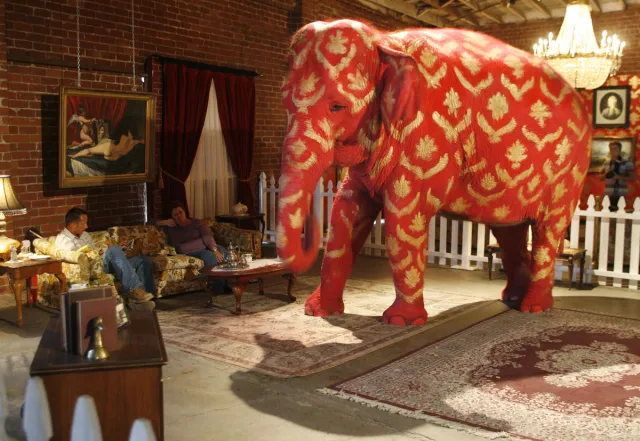
By 2006, word had spread far beyond Shoreditch. That September, Barely Legal opened in a vast warehouse in Los Angeles, billed as a "three-day vandalised warehouse extravaganza." The centrepiece was a 37-year-old Indian elephant named Tai, painted from head to tail in a red-and-gold wallpaper pattern to symbolise the "elephant in the room" — the global poverty that polite society ignores. Brad Pitt, Angelina Jolie, and Jude Law attended. Street art had officially entered the mainstream.
Two years later, in 2008, Banksy organised The Cans Festival in a dank tunnel beneath Waterloo Station in London. He invited dozens of street artists from around the world to paint the walls, transforming a forbidding space into an authorised graffiti gallery. That same year, the artist took over his hometown museum in the blockbuster exhibition Banksy versus Bristol Museum. He replaced historical artefacts with animatronic sculptures and satirical interventions — a burnt-out ice-cream van, a sculpture of a CCTV camera as a bird of prey. The show drew over 300,000 visitors.
One Nation Under CCTV — Banksy's three-storey 2008 mural opposite a working CCTV camera in Newman Street, London. Painted directly behind the camera that recorded its making, the work was destroyed by Westminster City Council in 2009. · Photo: Oxyman · CC BY 2.5Queues outside Banksy versus Bristol Museum, 2009 — the artist's blockbuster takeover of his hometown gallery drew over 300,000 visitors. · Photo: Jezhotwells · CC BY-SA 3.0
In 2010, Banksy directed and released his first feature-length documentary, Exit Through the Gift Shop. The film told the story of Thierry Guetta, a French immigrant in Los Angeles who compulsively filmed street artists but failed to do anything with the footage. When Guetta's edit proved incomprehensible, Banksy took control and crafted a narrative that charted Guetta's own rise as the art-world phenomenon "Mr Brainwash." The film earned an Academy Award nomination. Critics still debate whether it was a genuine documentary or an elaborate prank. Banksy has never clarified.
Era 3 · 2011–2019
Residency, Film & Self-Destruction
October 2013 saw a month-long "residency on the streets of New York" titled Better Out Than In. Every day, a new piece appeared somewhere across the five boroughs, announced via Instagram, triggering a city-wide treasure hunt. The works were accompanied by an audio-guide phone number that offered ironic commentary. On Day 13, Banksy set up a stall in Central Park and sold signed original canvases for $60 each. A handful of passers-by bought them. Total sales: $420. The estimated street value of those works at the time was roughly $225,000.
Next came his darkest and most ambitious installation. In August 2015, Banksy transformed a derelict seaside lido in Weston-super-Mare into Dismaland, a "bemusement park" and dystopian anti-Disneyland. Cinderella's carriage had crashed. Orcas jumped through hoops into toilet bowls. An anarchist training camp offered classes in how to break into bus billboards. The staff were instructed to be deliberately apathetic. Dismaland featured work from 58 artists, including Damien Hirst and Jenny Holzer, and drew 150,000 visitors over five weeks. After closing, the building materials were repurposed as shelters for refugees in the Calais Jungle.
Dismaland, 2015 — the dystopian 'bemusement park' built into a derelict lido in Weston-super-Mare. · Photo: Byrion Smith · CC BY 2.0
In March 2017, the artist opened The Walled Off Hotel in Bethlehem, a nine-room boutique guesthouse facing the concrete slabs and barbed wire of the Israeli West Bank barrier. Every room has what Banksy called "the worst view in the world." The interiors are covered in original works — a Palestinian and an Israeli locked in a pillow fight, surveillance cameras repurposed as decorative motifs. The presidential suite features a jacuzzi fed by a water tank speckled with bullet holes. It is simultaneously a hotel, an art installation, and a political statement. Rooms book out months in advance.
The entrance to The Walled Off Hotel in Bethlehem, opened in 2017 — the nine-room guesthouse facing the Israeli West Bank barrier. · Photo: Davide Mauro · CC BY-SA 4.0
On 5 October 2018, the canvas Girl with Balloon sold at Sotheby's London for £1.04 million. The moment the gavel fell, a hidden shredder built into the frame activated, and the painting began sliding through blades, half-destroying itself before a stunned auction room. Banksy posted a video of himself installing the shredder years earlier, captioned: "In case it was ever put up for auction." The buyer kept the work. Renamed Love is in the Bin, it resold in 2021 for £18.6 million — the most expensive piece ever sold by the artist.
In 2019, facing a trademark dispute from a greeting-card company, Banksy opened Gross Domestic Product, a shop in Croydon that never actually opened its doors. The window display featured the artist's version of household goods — from a disco ball made of a police riot helmet to a doormat stitched with the slogan "Welcome to Hell." The store was created solely to satisfy legal requirements around the use of his brand, turning litigation into yet another artwork.
Era 4 · 2020–2026
War, Pandemic & the Zoo
The pandemic years brought some of Banksy's most tender and urgent works. In May 2020, a new painting appeared at Southampton General Hospital: a boy playing with a nurse superhero doll, with Batman and Spider-Man figures discarded in a bin beside him. Titled Game Changer, it was accompanied by a note reading: "Thanks for all you're doing." When auctioned in 2021, it fetched £16.8 million, with all proceeds donated to the National Health Service. Later that year, Aachoo!!, a mural of an old woman sneezing with enough force to blow off her dentures, appeared on a house in Bristol.
In November 2022, Banksy travelled to Ukraine to paint seven murals in and around war-torn towns including Kyiv, Borodyanka, and Irpin. The works were acts of solidarity. The Gymnast showed a young girl doing a handstand on a heap of rubble from a destroyed tower block. The Judo Throw depicted a small boy flipping a large adult man resembling Vladimir Putin. Woman in Gas Mask appeared on a wall in Hostomel, her image both a record of daily reality and a gesture of defiance.
Children of War — one of the seven Banksy murals painted across war-torn Ukraine in November 2022. · Photo: Rasal Hague · CC BY-SA 4.0
The summer of 2023 brought Cut & Run in Glasgow, the artist's first authorised solo show in fourteen years. For the first time, Banksy revealed the original stencils used to create his most famous images, displaying them as artworks in their own right. The show was a meditation on process, offering a rare glimpse behind the curtain of a career built on secrecy.
August 2024 saw the London Zoo Series, a nine-day animal trail across the capital. It began with a mountain goat perched precariously on a wall near Kew Bridge. Each day, a new animal stencil appeared — monkeys, elephants, wolves, piranhas on a police sentry box — building a bestiary of urban life. The sequence culminated on Day 9 with a gorilla at London Zoo, lifting a shutter to release a sea lion and birds into the night. The series was a playful reminder that even a sprawling city remains a habitat.
In September 2025, a mural appeared on the Queen's Building at the Royal Courts of Justice in London, depicting a judge striking a protestor. Painted without permission, the work was swiftly removed by authorities owing to the building's listed status, but its message about the justice system had already been widely circulated online.
The Books, the Market & Authentication
Banksy's early trilogy of self-published books laid the literary foundation for a career built on words as much as images. Alongside them, a vast print market grew out of the Santa's Ghetto events and the Pictures on Walls collective. In total, over 170 unique print editions were produced between 2002 and 2022, spanning around 29,000 individual artworks. Early unsigned prints that once took days to sell out now command six-figure sums at auction. The comprehensive catalogue Banksy: The Prints documents these editions year by year, providing the definitive reference for collectors.
All authentic commercial works are verified exclusively by Pest Control Office, the artist's own authentication body established in 2008. Pest Control issues Certificates of Authenticity only for prints, paintings, and sculptures — never for street works or ephemera. The process is deliberately rigorous, designed to deter the flood of forgeries that have accompanied Banksy's success. The official website remains defiantly minimal: a single page linking to social media, a mailing list for occasional print releases, and an FAQ disavowing any connection to the unauthorised touring exhibitions that have proliferated globally.
Identity & the Dragon Bar's Legacy
The identity question has never been definitively resolved, and that is central to the project. Investigative journalism has long pointed to a Bristol-born artist named Robin Gunningham. A 2003 BBC interview captured the artist confirming his first name as "Robbie." DJ Goldie once referred to a friend called "Rob," and Massive Attack's Robert Del Naja has frequently been linked to the work. The artist himself has never confirmed any theory, and the refusal to do so has become an artistic statement in its own right.
The Dragon Bar, where so much of this began, closed its doors in 2008 after a fire swept through the premises. It never reopened. In the years since, those who were there have come to recognise the bar as a moment in art history. A 300-page oral history now documents the story through contributions from Banksy, Eine, Faile, Invader, Mode 2, Sweet Toof, Aiko, James Jessop, and many more. It captures what the regulars always knew: in a shabby room above a pub in Shoreditch, with gloriously graffitied toilets and a loose grip on rules, a new movement was born.
Today, Banksy's Instagram following runs into the millions, and a new stencil on a city wall remains an international news event. The work continues to appear without warning, in places of conflict and on the sides of hospitals, always anonymous, always impossible to ignore. The definitive account of the world's most elusive artist may never be written — and perhaps that is exactly how it is intended to remain.
Three Decades of Disruption
A journey from Bristol walls to global icon
2000
London Calling
Banksy brings his stencil revolution to London. The city's walls become his gallery, attracting attention from collectors and the Metropolitan Police in equal measure.
2002
First LA Exhibition
'Existencilism' debuts at 33⅓ Gallery in Los Angeles, introducing American audiences to works like 'Barcode,' 'Bomb Hugger,' and 'Love Is In The Air.' The West Coast takes notice.
2006
Barely Legal
The warehouse show that changed everything. A live elephant painted in pink wallpaper patterns stands in a Los Angeles warehouse alongside provocative new works. Brad Pitt, Angelina Jolie, and Jude Law show up. Street art officially enters the mainstream.
2010
Exit Through the Gift Shop
Banksy's documentary about French videographer Thierry Guetta earns an Oscar nomination. The art world debates whether it's real or an elaborate prank. Banksy doesn't clarify.
2013
Better Out Than In
A month-long New York 'residency' featuring one new piece every day. Locations announced via Instagram, treasure hunt ensues. On Day 13, he sells original works for $60 each from a Central Park stand. Total sales: $420. Street value: roughly $225,000.
2015
Dismaland
Banksy transforms a derelict seaside lido in Weston-super-Mare into a 'bemusement park'—a dystopian anti-Disneyland. Cinderella's crashed carriage. Orcas jumping through hoops in toilet bowls. Apathetic staff who'd rather look at their phones. It's dark, brilliant, and sells out immediately.
2017
The Walled Off Hotel
Banksy opens a hotel in Bethlehem, directly facing the Israeli West Bank barrier. Every room has the 'worst view in the world.' The walls are gallery spaces. It's equal parts art installation, political statement, and functioning hotel. Rooms book out months in advance.
2018
The Shredder Heard Round the World
'Girl with Balloon' sells at Sotheby's for £1.04 million. The moment the gavel falls, a shredder hidden in the frame activates. The canvas slides through, half-destroyed. The art world collectively gasps. The buyer keeps it. Three years later, it resells as 'Love is in the Bin' for £18.6 million.
2020
Game Changer
During COVID-19's peak, Banksy donates a painting to Southampton General Hospital: a boy playing with a nurse superhero doll. When it auctions in 2021, it fetches £16.8 million. All proceeds go to the NHS.
2021
Auction Records Shattered
'Love is in the Bin' becomes the most expensive Banksy ever sold at £18.6 million ($25.4 million). The half-shredded piece that shocked the world now holds the record.
2022
Ukraine Murals
Banksy travels to war-torn Ukraine and paints seven murals across Kyiv, Borodyanka and Irpin. A young gymnast handstands on the rubble of a destroyed tower block. A small boy flips a Putin-resembling adversary in a judo throw. A woman in a gas mask appears on a wall in Hostomel. Acts of solidarity, executed under impossible conditions.
2023
Cut & Run
The first authorised solo show in 14 years opens in Glasgow. For the first time, Banksy reveals the original stencils used to create his most famous works—displayed as artworks in their own right. A rare meditation on process from a career built on secrecy.
2024
London Zoo Series
A nine-day animal trail across the capital. A mountain goat on a wall by Kew Bridge. Monkeys, elephants, wolves, piranhas on a police sentry box. The sequence ends with a gorilla at London Zoo lifting a shutter to release a sea lion and birds into the night. A bestiary of urban life.
2025
Royal Courts of Justice
A mural appears on the Queen's Building at the Royal Courts of Justice in London depicting a judge striking a protestor. Painted without permission, swiftly removed by authorities owing to the building's listed status—but not before its message about the justice system had circled the globe online.
2025-26
The Mystery Continues
New identity theories emerge. Auction prices stabilize after the pandemic boom. Print values correct but remain strong. Museums begin acquiring works. Banksy's Instagram hits 12+ million followers. And still—still—no one knows for certain who's behind it all.
Documentary · Vision Films · 2020
Banksy and the Rise of Outlaw Art.
In 2020 Vision Films released a feature-length account of how a Bristol graffiti writer became the most politically consequential artist of the 21st century. The trailer below offers a two-minute primer — for collectors who want context beyond the auction headlines, it's the single most useful introduction we know.
Pest Control Office is the only entity authorized to authenticate Banksy prints. Established in 2008, they issue Certificates of Authenticity (COAs) essential for buying, selling, or insuring works. No COA, no deal—the market won't touch it.
Market Performance
Signed prints: £35,000-£500,000+. Unsigned: £12,000-£100,000+. After the 2020-21 boom and subsequent correction, the market has stabilized. Icons like ‘Girl with Balloon’ consistently outperform. 20-year CAGR: 26% for signed editions.
What to Look For
Edition size (signed/150 vs unsigned/600), condition (pristine is king), provenance (documented history), and iconography (recognizable images command premiums). First-market appearances and rare colorways generate buzz, but buy the image you love.
Explore Our Banksy Collection
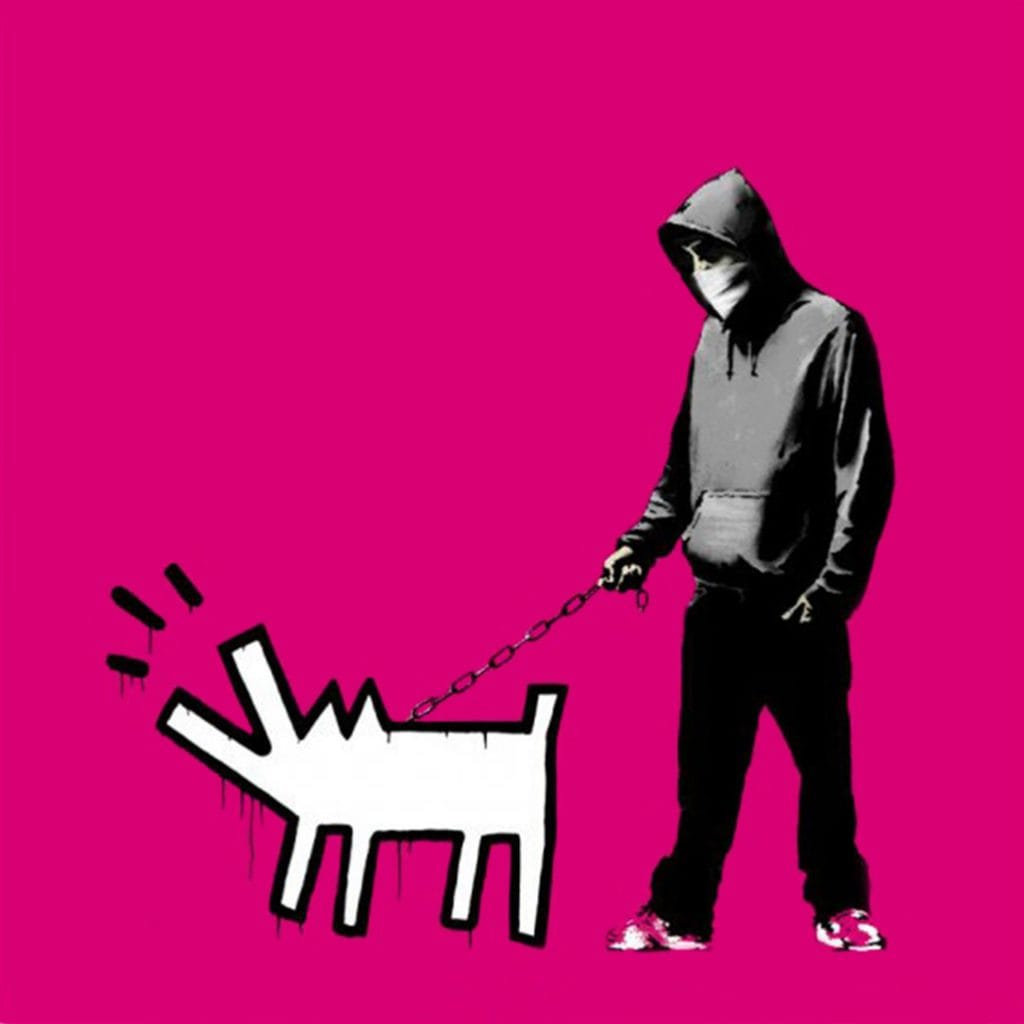
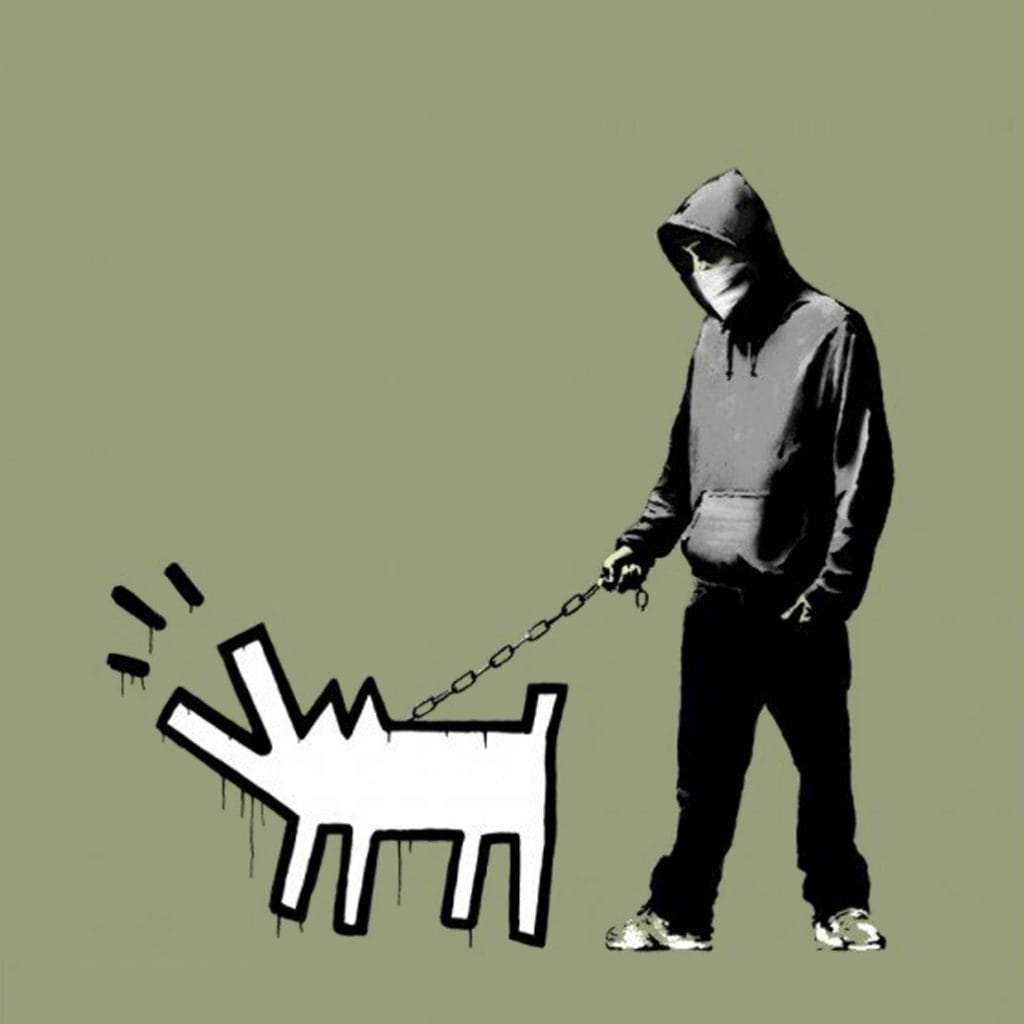
From iconic Girl with Balloon editions to rare Choose Your Weapon colorways— every Banksy at Zebra One Gallery is sold with a Pest Control Office Certificate of Authenticity.
All works certified • Price on request
Own a Banksy?
Zebra One Gallery specialises in Banksy consignment and resale. We only handle works that already carry a Pest Control Office Certificate of Authenticity, and connect you with serious collectors worldwide.
Pest Control COA Required
We only handle works with an existing Pest Control Certificate of Authenticity
Competitive Rates
Transparent commission structure
Global Network
Access to serious international collectors
Cookies on Zebra One Gallery
We use essential cookies to make this site work, plus optional analytics and marketing cookies to understand how the gallery is used and to show relevant artwork. Read our privacy policy or cookie policy.